Moving art in Dubai without damaging it
Moving is when most things can go wrong at once. Photograph the work first, wrap it for the trip it will really take, travel in an air-ride vehicle with temperature control, and leave the crate closed for 24 hours when it arrives.
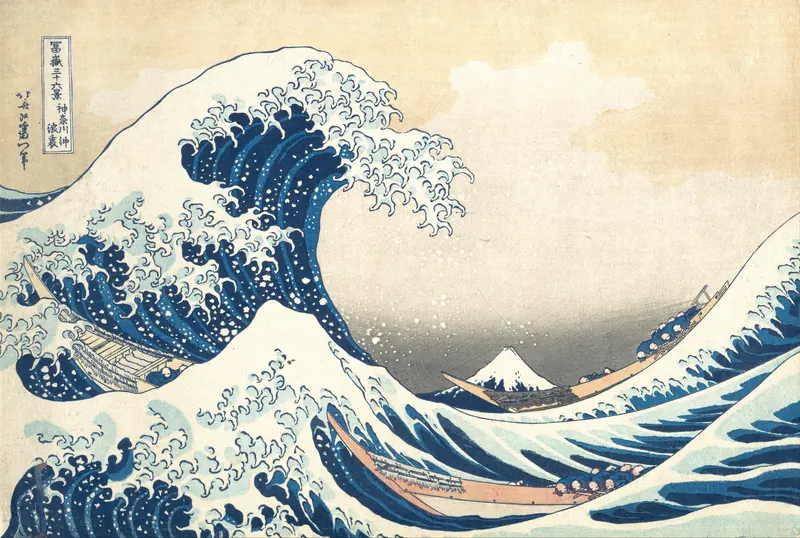
Under the Wave off Kanagawa, ca. 1830-32
Woodblock print; ink and color on paper
The Metropolitan Museum of Art, New York, Open Access, public domain (CC0). Reproduced for its material, not held in any store named here.
Before anyone touches it
Photograph each work and note what is already wrong with it. CCI asks for this before any travel (CCI). ICOM's Object ID sets out a short standard description that also helps if a work is ever lost or stolen (ICOM Object ID): keep it somewhere other than the crate.
Wrapping
CCI's sequence for a painting: a first layer of Mylar, then bubble wrap or thin polyethylene foam. A sealed waterproof layer of polyethylene sheet or Mylar film protects against humidity swings on the way (CCI). On glazed work, a grid of low-tack tape on the outside of the glass keeps shards in place if it breaks; take it off soon after travel. Acrylic glazing carries less risk.
Crate or not
For most paintings CCI describes a well-made wooden crate with bumpers and handles, and compressible padding that stops the work shifting and absorbs shock (CCI). A short drive across Dubai for a modest framed print may not need one. A loan to Riyadh does. Let the value of the work and the number of hands decide.
On the road
Ask for air-ride vehicles with temperature control, and never let crates sit outside. In this city a crate on a loading bay in July is the failure to plan against. dnata logistics states that its vehicles are covered and air conditioned. Crown, Equinox, JKK and Dubai Fine Arts all state local transport.
Arriving: leave it shut
CCI asks for 24 hours for crate and contents to adjust before opening, to prevent condensation on cold surfaces (CCI). The Hammer Museum at UCLA keeps a painting crated for at least that long (Hammer Museum). That advice is written for work that has been out in the cold. Our reading for Dubai: the same physics runs the other way when a cold crate leaves an air-conditioned store for a humid afternoon, so keep it wrapped until it is back in conditioned air.
Julia Jackson, 1867
Albumen print from wet collodion negative
The Cleveland Museum of Art, Open Access, CC0. Reproduced for its material, not held in any store named here.
Questions for your broker
- Is this nail to nail? In one published policy wording that means cover starts when the work leaves the wall and includes packing. Marsh describes cover that spans premises, transit, loan and storage. Confirm that your own policy reads the same way.
- Is the value agreed? Trade press calls agreed value the usual basis for private collections (Atlas Magazine). Ask whether yours is agreed or assessed after a loss.
- What does the carrier owe if I have no art policy? US legal commentary notes that default liability can be tied to weight rather than value (Flaster Greenberg). That is not UAE law, so ask what your carrier's terms say here.
- Who insures it in the store? Equinox leaves it to the customer. Dubai Fine Arts says it provides cover. Vachi offers optional cover from AED 49 a month, which is written for belongings, so check whether the limit means anything for your work.
Who can do which part
Whole job, crate to wall. Crown, Equinox, Dubai Fine Arts, Bovis and JKK all state crating, installation, local transport and shipping. DIETL states all but crating on the page read. Dubai Art Depot handles and ships, and its own storage unit is still under development.
Into a room in Dubai. Vachi collects into storage for free anywhere in Dubai, with packing labour included and materials extra. Return delivery costs AED 450 to 700, and art handling is a separate quote. That suits sound, framed work in a local move. Crates and fragile surfaces belong with the firms on the left.