Art customs in Dubai: duty, temporary admission and ATA carnets
Art arriving in Dubai normally meets the 5% general customs duty on its CIF value, plus 5% VAT on import. A temporary admission or an ATA carnet avoids paying duty on a work that will leave again. A free zone defers the question instead of removing it.
This is a reading of public sources, checked November 2026, and it is not legal or tax advice. No art-specific duty line could be confirmed, so have a customs broker confirm the treatment of your work before it ships.
Buying a work and bringing it to the mainland
Dubai Customs' service guide gives a general duty of 5% of CIF value, with exceptions for alcohol and tobacco (Dubai Customs guide). The FTA lists VAT at 5% (FTA). Ask your broker whether anything reduces this for your HS code, and what value customs will accept.
In for an exhibition, then out
The GCC Common Customs Law covers items temporarily imported for exhibitions and like events (Art. 90). Dubai Customs takes a deposit equal to the duty and refunds it on re-export within the allotted time.
Travelling on an ATA carnet
A carnet from Dubai Chambers is a customs document for temporary import and export without duties or taxes. Chambers lists fees of AED 900 to 2,300, 1 to 2 business days of processing, and a security deposit worked out from invoice value and tax.
Two sources give different periods, so check yours. Dubai Customs says admission lasts 6 months or the carnet's validity, whichever is less, with no customs deposit on the goods. Chambers describes the carnet as running for up to one year. DIETL states an in-house team for carnets and temporary admissions; ask your own shipper if they handle them.
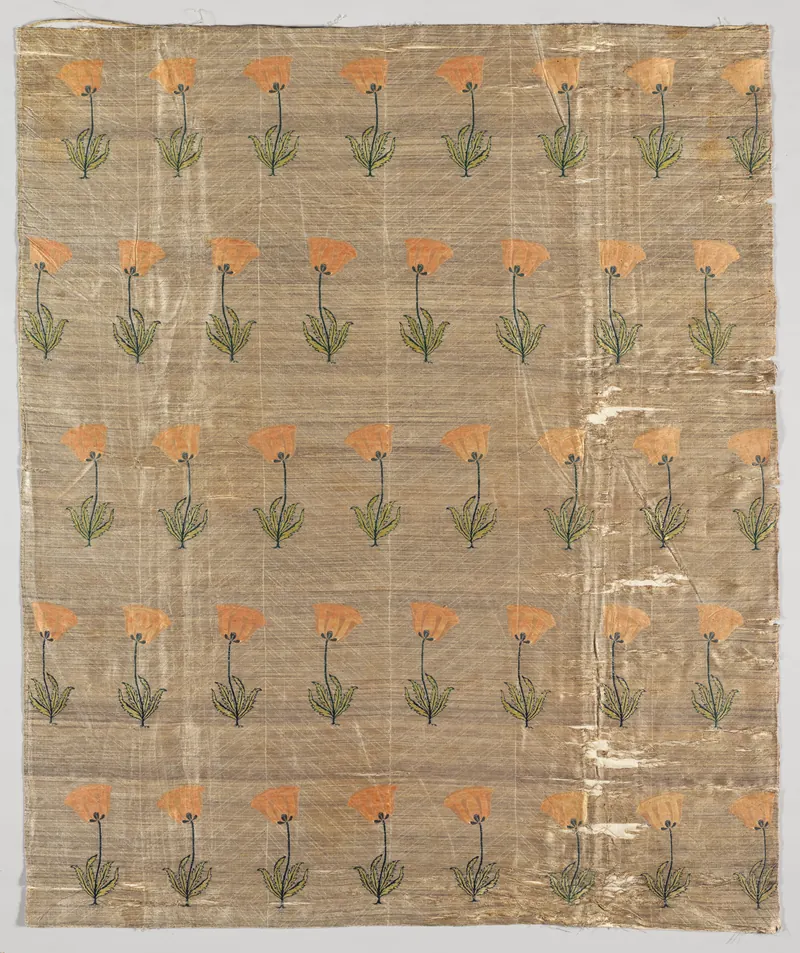
Textile with field of poppies on a golden ground, 1600-1750 Silk and gilt-metal thread: twill weave with supplementary weft, stamped The Cleveland Museum of Art, Open Access, CC0. Reproduced for its material, not held in any store named here.
Holding it in a free zone
Foreign goods can enter a free zone and leave the country without duty (GCC law, Art. 78). Bring them into the country and they count as foreign goods, so duty applies then (Art. 88). Equinox describes a customs-bonded warehouse and Brink's a customs-bonded zone. Treat that as the operator's description, and ask what happens on the day the work leaves.
VAT and the zone
The FTA treats a move from a Designated Zone to the mainland as an import, with VAT payable by the importer (FTA guide). Not every free zone is automatically treated alike, so ask your adviser whether yours is a Designated Zone. Do not rely on a provider's marketing line about VAT.
Antiquities and old objects
Dubai Law No. 11 of 2026 bars bringing a movable antiquity into the emirate, including for sale or export, unless lawful possession is established by authenticated official documents (Dubai Legislation Portal). It also addresses taking private antiquities out. The Dubai Customs guide lists works of art, collectors' pieces and antiquities in an appendix under the National Media Council. This guide could not confirm which body handles those approvals today, or what applies to non-antique art leaving the UAE. Ask before you book the flight.
Auguste Rodin The Thinker, 1880-81 Bronze The Cleveland Museum of Art, Open Access, CC0. Reproduced for its material, not held in any store named here.
Keep in the file
Purchase invoice and any prior import or export paperwork.
Your Object ID record and condition photographs.
Provenance documents. ICOM's Code of Ethics treats due diligence and provenance as central against illicit traffic (ICOM). This guide found no official UAE list of what to hold, so ask your broker what they require.
Staying local? A work already cleared and kept in Dubai should raise no new customs question when it moves to a room at Vachi Storage or a similar mainland store. If it came in on temporary admission, ask first. The facilities table shows who is where.